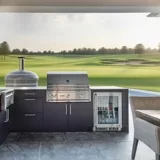
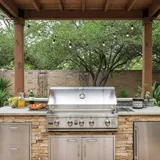
Tell us about the space and the build you have in mind, and we will route the request to licensed local outdoor kitchen professionals who cover your area. It is free, there is no obligation, and the professional holds the contract — not us.
What to have ready before you send
The more of this you can put in the request, the fewer rounds of questions before a real number comes back.
- Counter run length and layout. Length in linear feet and roughly what you want along it — grill, counter, bar seating, storage. Published counter-run rates run from $200-350/lf for a framed island with a poured concrete counter to $450-900/lf for a kitchen under a pergola or patio cover, so the length and the material are what place your job on that scale.
- The appliance package. Built-in gas grill, pizza oven, outdoor-rated refrigerator, sink, side burner, smoker or kamado station, kegerator or beverage centre. Installed ranges are published for each — 300 – 2,000 for a sink with plumbing against 1,500 – 5,000 for a built-in gas grill — and weather-rated equipment carries a 30 to 50 percent premium over indoor models.
- Where the gas, water and power already are. Whether a gas line, a water line and a circuit reach the patio, and where the meter and the panel sit. A gas line run from the meter is 400 – 2,000 on its own.
- What the base is now. A 4-inch reinforced concrete slab on compacted gravel is the standard base for masonry and stone builds. Say what is there, including any wood deck — wood decks are not designed for the weight and heat of masonry and built-in grills, and need a structural engineer review and heat shielding or the deck may sag and pose a fire risk.
- Cover or pergola. Decide this before the concrete work starts, because it affects the layout as well as the cost.
- Permit and HOA position. Whether anything has been filed yet, and whether your association has been approached.
- Your town, or the nearest crossroads if you are outside a town limit.
Decide on the cover before anything is poured
Plan for counter space — it goes fast once you are cooking — decide on a cover or pergola early because it affects the layout, and confirm gas and electrical runs before the concrete work starts. Homeowners who build under cover consistently say ventilation and prep space are the two things they would never skip.
The cover is also the item most often left out of a first quote. Adding a pergola typically adds 4,000 to 12,000 including lighting, ceiling fans or retractable covers, a full kitchen-and-pergola package lands at 30,000 and 50,000, a wood pergola is published at 3,000 to 8,000, and aluminum or steel structures with louvers at 8,000 to 20,000. If the kitchen will sit under a roof or an enclosure rather than open air, say so: covered or enclosed areas require a rated vent hood, and an under-counter grill or enclosed room without airflow traps smoke and heat and damages finishes.
Service area and permits
We route requests across Phoenix and the surrounding Maricopa County area in the Valley of the Sun, so tell us the town and we will match with professionals who work there. Permits are issued by Inside Phoenix, residential outdoor-kitchen work is permitted by the City of Phoenix Planning & Development Department (PDD), which issues residential building, gas, plumbing, mechanical and electrical permits, runs plan review and inspects, from the permit centre at 200 W. Washington St. (https://www.phoenix.gov/administration/departments/pdd/residential-building.html, HTTP 200). PDD's own guide puts detached structures without utilities of 200 sq ft or less and uncovered patio slabs or decks less than 30 inches above grade outside permit scope, while attached patio covers or ramadas, gas lines and gas-fired equipment, electrical circuits, sinks/sewer/water lines and change-of-drainage conditions all require one (How to Obtain a Residential Permit, https://www.phoenix.gov/pddsite/Documents/TRT/dsd_trt_pdf_00823.pdf, HTTP 200). Properties in unincorporated Maricopa County are permitted by the county rather than the city (https://www.maricopa.gov/1385/Permit-Application, HTTP 200). and typically carry an allowance of 75 – 400. Gas line work, new electrical circuits and any covered structure usually need a permit, and HOA approval is separate through HOA approval is the most commonly skipped step on Valley outdoor kitchens and it is close to universal in the master-planned neighbourhoods. Before construction, get the CC&R architectural submittal - plot plan, elevations, material and colour schedule, and often the gas-fire-feature detail - approved in writing. Arizona regulates this under the Planned Communities Act (A.R.S. Title 33, Chapter 16): § 33-1817(B) requires the design or architectural committee to include at least one board member serving as chairperson and provides that approval of a construction project's architectural designs and plans 'shall not unreasonably be withheld' (https://www.azleg.gov/ars/33/01817.htm, HTTP 200), and § 33-1803 requires notice and an opportunity to be heard before penalties are imposed and caps late-payment charges (https://www.azleg.gov/ars/33/01803.htm, HTTP 200). Check the recorded plat for what the association actually owns or controls - walls, view fences, common-area landscape strips and easements - because the association cannot approve construction that a utility easement forbids.. Covers and pergolas usually need a setback from the property line, and the inspection sequence on a covered structure runs a gas pressure test, an electrical rough-in and a final inspection.
Whatever the jurisdiction, confirm which one applies before anything is scheduled — a professional who works in your area will know whether the permit comes from the city, the county or a separate authority, and who is filing it.
How the request form works
It takes under two minutes to describe a project, and that is the whole form. Describe the counter run, the appliances, the base and the cover, and the request is routed to up to three local outdoor kitchen professionals. Two minutes of accurate detail is what lets them quote usefully instead of calling to ask what you meant.
Requests are normally answered within one business day, and no more than three local professionals receive your details. Nothing is sold or rented beyond the providers you are matched with. When you are ready, use the connect-me-with-a-pro form — there is no charge, no obligation, and choosing to hire nobody costs nothing. Our role ends at the introduction: the professional you select holds the contract, the licence and the warranty, and handles everything from permits to cleanup.
Frequently asked questions
Is there a charge for matching?
No. Homeowners pay nothing for the matching service and there is no obligation to accept any quote that comes back.
What is the one detail that most changes my quote?
Whether the gas, water and electrical lines already reach the site. Running gas, water and electric lines is 2,000 to 5,000, and underground line runs and trenching add 500 to 2,000 that many quotes leave out. The base comes next: masonry and stone builds want a 4-inch reinforced concrete slab on compacted gravel, and pavers shift under heavy masonry and appliances.
What if I am outside a town limit?
We route across Phoenix and the surrounding Maricopa County area. Give us the town and, if you are outside a town, the nearest crossroads.