Outdoor cooking means a grill or smoker in the yard. An outdoor kitchen is a built-in space with countertops, storage, refrigeration, and often a sink, bar seating, and a pergola or roof. Those two definitions are the two ends of a spectrum, and the published numbers put real distance between them: a grill station with a small counter runs 2,000 to 5,000 and takes 1–2 weeks, while a full build runs 15,000–40,000 and takes 4–8 weeks. The decision is not about ambition. It is about whether the cooking you actually do needs one heat source and a landing zone, or a room outside with water, power and cold storage in it.
What a Grill Station Is and What It Costs
2,000 to 5,000 buys a grill station with a small counter, and that figure is the whole job rather than the appliance alone. The grill is priced on its own line, and the installed range for a built-in gas grill is 1,500 – 5,000. A built-in grill is also published at 2,000 to 8,000, and the two figures describe different scopes: one is an installed appliance in a counter, the other is an appliance-led station budget.
What Changes When It Becomes a Full Kitchen
The published bands for the full version are 8,000 and 15,000 for a basic outdoor kitchen with a built-in grill and modest countertops, 15,000 and 35,000 for a typical project, and 25,000 to 50,000 for a custom build with pergola, refrigeration, cabinetry, sink and outdoor fireplace. The checklist's budget instruction for the same job is 10,000 to 50,000 depending on appliances, stone, and utilities.
The parts that make it a kitchen are the parts that need a connection: a sink with plumbing at 300 – 2,000, an outdoor-rated refrigerator at 800 – 3,500, and the utility runs themselves at 2,000 to 5,000 for gas, water and electric together, plus 500 to 2,000 for the underground line runs and trenching that many quotes leave out. That is the turning point between the two projects. A grill station is a purchase. A full kitchen is construction.
How to Decide Between Them
Four questions settle it, and none of them is about budget alone.
- Do you need water? A sink with running water is a plumbing run and usually a permit. Without one, a grill station with a small counter covers most of what daily cooking requires.
- Do you need cold storage? An outdoor-rated refrigerator needs power and a ventilated cavity to shed heat, and an outdoor kitchen's refrigeration is part of what separates it from outdoor cooking.
- Do you want cover? Decide on a cover or pergola early because it affects the layout, and plan for counter space, because it goes fast once you are cooking.
- Is the base and the utility work ready? Confirm gas and electrical runs before the concrete work starts, and remember that wood decks are not designed for the weight and heat of masonry and built-in grills.
What the Space Returns at Resale
The valuation figure behind the whole decision is that homeowners recover 55 to 70 percent of project cost at resale, and outdoor kitchens are valued as usable living space more than curb appeal. A space that gets used daily earns that description faster than a room that gets used twice a season.
The Local Variables in the Decision
Which option performs best in Phoenix's climate and soil conditions is a local question, and the two variables that decide it are the weather and the ground: Phoenix is a 110 F-plus summer metro with an extreme-UV load and a storm-peaked monsoon. The NWS Phoenix forecast office publishes daily probability tiers for the metro at 100, 105, 110 and 120 F and keeps a running yearly count of Phoenix days at or above 110 F (https://www.weather.gov/psr/heat, HTTP 200), and the monsoon season runs through September 30, bringing the dust storms (wind gusts 40-60 mph) and thunderstorms NWS calls the most dangerous weather period of the Southwest year (https://www.weather.gov/psr/MonsoonSafety, HTTP 200). Sun load is the second half of the exposure: on EPA's UV Index scale everything at 8 and above is 'very high to extreme', where EPA advises extra protection even outside of peak hours (https://www.epa.gov/sunsafety/uv-index-scale-0, HTTP 200). The practical consequences for an outdoor kitchen are that shade and heat/UV tolerance drive material selection rather than looks, and that the usable season inverts: roughly October through May is the comfortable cooking season, while June through September is the survival season for both people and finishes.
Frequently asked questions
How much does a grill station cost?
2,000 to 5,000 for a grill station with a small counter. The installed range for a built-in gas grill on its own is 1,500 – 5,000, and a built-in grill is also published at 2,000 to 8,000.
How long does each project take?
1–2 weeks for a grill station against 4–8 weeks for a full outdoor kitchen. From a signed agreement the published window is two and six weeks, and custom stone and special-order grills can stretch the timeline to 12 weeks.
Is a full outdoor kitchen worth the extra cost?
It depends on how the space is used. A custom build with pergola, refrigeration, cabinetry, sink and outdoor fireplace runs 25,000 to 50,000, and homeowners recover 55 to 70 percent of project cost at resale, with outdoor kitchens valued as usable living space more than curb appeal.
Can I start with a grill station and extend it later?
Often yes, if the base is planned for it. A 4-inch reinforced concrete slab on compacted gravel is the standard base for masonry and stone builds, and prefab outdoor kitchens are described as faster, modular and lower cost than a fully custom build.
Sources
- Phoenix Outdoor Kitchens — grill station versus full outdoor kitchen comparison (published rows)
- Phoenix Outdoor Kitchens — outdoor kitchen cost calculator model (installed add-on ranges)
- Phoenix Outdoor Kitchens — outdoor kitchens FAQ (published cost bands and timelines)
- National Weather Service
Related
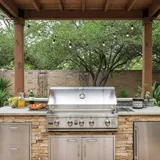
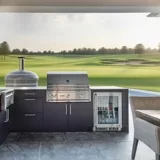
Outdoor Kitchens services in Phoenix
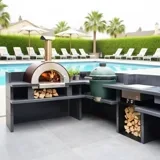
Phoenix Outdoor Kitchen Construction
A built-in outdoor kitchen is a permanent structure before it is a cooking appliance, and the published numbers only make sense once you know which of the two you are paying for.
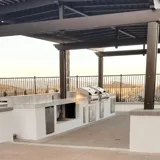
Phoenix Outdoor Kitchen Pergola And Patio Cover
A shade structure is the part of an outdoor kitchen that decides how many months of the year the rest of it actually gets used.
Phoenix Outdoor Kitchen Fireplace
An outdoor fireplace is built around one 1,800-degree event, and every part of the specification exists because of it.
Phoenix Outdoor Kitchen Bar Construction
An outdoor bar is two jobs in one structure: a counter run built to bar height, and a small commercial beverage system with water, power and a drain.
Phoenix Outdoor Kitchen Lighting
Outdoor lighting is specified in layers, not in fixtures, and any one layer on its own fails at exactly the job it was bought for.
Phoenix Outdoor Kitchen Pizza Oven
A pizza oven is a masonry appliance: the heat is the easy part, and the footprint, the mass and the clearance to combustibles are what the build is really about.
Areas we serve
Phoenix
Outdoor Kitchens in Phoenix, AZ - costs, water and soil notes.
Scottsdale
Outdoor Kitchens in Scottsdale, AZ - costs, water and soil notes.
Chandler
Outdoor Kitchens in Chandler, AZ - costs, water and soil notes.
Gilbert
Outdoor Kitchens in Gilbert, AZ - costs, water and soil notes.
Mesa
Outdoor Kitchens in Mesa, AZ - costs, water and soil notes.
Tempe
Outdoor Kitchens in Tempe, AZ - costs, water and soil notes.
Glendale
Outdoor Kitchens in Glendale, AZ - costs, water and soil notes.