Every homeowner who has been burned by a bad build says the same thing afterwards: the warning signs were there in the first conversation. The useful part is knowing which checks actually predict the outcome. Five of them do the heavy lifting — whether the company builds outdoors rather than indoors, whether its insurance is current, whether its references are recent, whether its warranty lasts more than a season, and whether it can explain what wind, rain and freeze-thaw do to a footing. None of them requires construction knowledge, and all of them can be checked before a deposit changes hands.
Check One: Outdoor Kitchens, Not Indoor Remodels
The first question is not how long the company has been building, it is what it has been building: confirm the contractor has built outdoor kitchens, not just indoor remodels. Indoor finish work and outdoor structure work fail in different places. An indoor remodel is protected by a roof and a conditioned envelope; an outdoor kitchen stands in the weather with sun on the counter, rain on the island and water in the ground under the footing.
Check Two: Current General Liability and Workers Comp Insurance
Ask directly, in writing: verify the company carries current general liability and workers comp insurance, and ask for the certificate before work starts rather than after. The request is routine rather than insulting — associations expect the same paperwork, and the HOA document list includes the contractor insurance certificate and licence for the file.
Check Three: References From the Last Two Years
Request references from outdoor projects completed in Phoenix in the last two years. Two years is not an arbitrary window. It is recent enough that the owner still remembers the schedule and the punch list, and long enough that any re-seal or drainage issue has had time to appear.
Check Four: A Warranty of at Least One Year of Work
Confirm the structure warranty covers at least one year of work. Published warranty terms separate the parts of the job rather than covering them in one sentence: workmanship 1-3 years, structure and masonry 5-10 years, countertop 1-10 years, and appliances 1-5 years manufacturer. Four clocks run on one build, and a single unqualified warranty answer is not an answer.
Read the exclusions as carefully as the term. Most contracts exclude freeze damage, UV fading of the counter sealant, and damage from uncovered appliances. Those exclusions are also a maintenance brief: they describe exactly what a cover and an annual walk are for.
Check Five: Wind, Rain and Freeze-Thaw
Ask how the build handles wind, rain, and freeze-thaw in your climate, and listen for detail rather than reassurance. The published substrate anatomy runs bottom-up: concrete base, waterproof layer, plumbing penetrations, aggregate finish. The concrete base carries the full dead and live load; the plumbing penetrations are the deliberate holes through both, and they are where water gets in.
The base itself is checkable. A 4-inch reinforced concrete slab on compacted gravel is the standard base for masonry and stone builds, and pavers work for lighter builds but shift under heavy masonry and appliances. The slab should slope away from the structure and include a floor drain if it has a sink or ice maker, because poor drainage leads to standing water, moss, and rusted appliance bases.
What the local weather and ground actually do to a specification: Phoenix is a 110 F-plus summer metro with an extreme-UV load and a storm-peaked monsoon. The NWS Phoenix forecast office publishes daily probability tiers for the metro at 100, 105, 110 and 120 F and keeps a running yearly count of Phoenix days at or above 110 F (https://www.weather.gov/psr/heat, HTTP 200), and the monsoon season runs through September 30, bringing the dust storms (wind gusts 40-60 mph) and thunderstorms NWS calls the most dangerous weather period of the Southwest year (https://www.weather.gov/psr/MonsoonSafety, HTTP 200). Sun load is the second half of the exposure: on EPA's UV Index scale everything at 8 and above is 'very high to extreme', where EPA advises extra protection even outside of peak hours (https://www.epa.gov/sunsafety/uv-index-scale-0, HTTP 200). The practical consequences for an outdoor kitchen are that shade and heat/UV tolerance drive material selection rather than looks, and that the usable season inverts: roughly October through May is the comfortable cooking season, while June through September is the survival season for both people and finishes.
What the Matching Service Does Not Do
What it does not do: it does not build, inspect, quote or guarantee the work. We do not employ contractors and we do not sell outdoor kitchens services. Our role as an independent matching service ends when you choose your pro, and we do not take commissions or mark up prices.
Frequently asked questions
How do I know a builder has really built outdoor kitchens?
Confirm the contractor has built outdoor kitchens, not just indoor remodels, and ask for photographs and references from outdoor projects completed in the last two years. A portfolio of interior work does not answer the question.
What insurance should an outdoor kitchen builder carry?
Verify the company carries current general liability and workers comp insurance before work starts. Ask for the certificate and keep it with the contract and the warranty paperwork.
What warranty should I expect on an outdoor kitchen?
Published terms separate workmanship at 1-3 years, structure and masonry at 5-10 years, countertop at 1-10 years and appliances at 1-5 years manufacturer. Ask for at least one year of work on the structure, and read the exclusions.
Does the matching service verify the builders it sends?
It checks state licensing and insurance coverage where that information is available and reviews public ratings, and provider profiles show a verification date. That is a check on documents, not a guarantee of the work.
Sources
- Phoenix Outdoor Kitchens — outdoor kitchens checklist (builder vetting and utility gates)
- Phoenix Outdoor Kitchens — outdoor kitchens FAQ (published warranty and lifespan bands)
- Phoenix Outdoor Kitchens — how it works (provider vetting and transparency answers)
- USDA-NRCS Web Soil Survey
Related
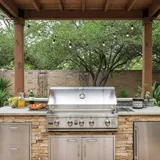
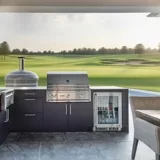
Outdoor Kitchens services in Phoenix
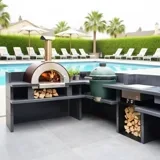
Phoenix Outdoor Kitchen Construction
A built-in outdoor kitchen is a permanent structure before it is a cooking appliance, and the published numbers only make sense once you know which of the two you are paying for.
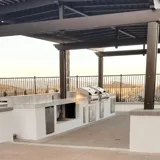
Phoenix Outdoor Kitchen Pergola And Patio Cover
A shade structure is the part of an outdoor kitchen that decides how many months of the year the rest of it actually gets used.
Phoenix Outdoor Kitchen Fireplace
An outdoor fireplace is built around one 1,800-degree event, and every part of the specification exists because of it.
Phoenix Outdoor Kitchen Bar Construction
An outdoor bar is two jobs in one structure: a counter run built to bar height, and a small commercial beverage system with water, power and a drain.
Phoenix Outdoor Kitchen Lighting
Outdoor lighting is specified in layers, not in fixtures, and any one layer on its own fails at exactly the job it was bought for.
Phoenix Outdoor Kitchen Pizza Oven
A pizza oven is a masonry appliance: the heat is the easy part, and the footprint, the mass and the clearance to combustibles are what the build is really about.
Areas we serve
Phoenix
Outdoor Kitchens in Phoenix, AZ - costs, water and soil notes.
Scottsdale
Outdoor Kitchens in Scottsdale, AZ - costs, water and soil notes.
Chandler
Outdoor Kitchens in Chandler, AZ - costs, water and soil notes.
Gilbert
Outdoor Kitchens in Gilbert, AZ - costs, water and soil notes.
Mesa
Outdoor Kitchens in Mesa, AZ - costs, water and soil notes.
Tempe
Outdoor Kitchens in Tempe, AZ - costs, water and soil notes.
Glendale
Outdoor Kitchens in Glendale, AZ - costs, water and soil notes.