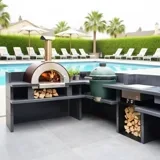
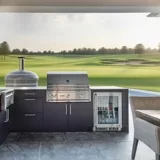
A pizza oven is published as wood-fired or gas, reaching 800 degrees for authentic Neapolitan pizza in 90 seconds, and doubling as a bread oven. Installed, a pizza oven is published at 1,000 - 8,000 as an add-on, while pizza ovens and rotisseries as a category run 1,500 to 6,000, and the site-wide project band is 15,000 and 35,000. Inside a full build the oven is usually one of three heat sources on a single island: the published example is a 12 feet by 4 feet chef's island carrying three heat sources, paired with a 6-foot linear fire feature, which requires a dedicated footprint, masonry mass, and clearance to combustibles. Phoenix Outdoor Kitchens is an independent matching service, not a provider - we route your request to licensed local builders.
What it costs in Mesa
| Job | Published 2026 range |
|---|---|
| Built-in gas grill, installed | 1,500 - 5,000 |
| Pizza oven, installed | 1,000 - 8,000 |
| Outdoor-rated refrigerator | 800 - 3,500 |
| Sink with plumbing | 300 - 2,000 |
| Gas line run from the meter | 400 - 2,000 |
| Low-voltage lighting package | 500 - 1,500 |
| Running gas, water and electric lines together | 2,000 - 5,000 |
| Underground line runs and trenching | 500 - 2,000 |
| Permit allowance | $75 - $400 |
| Removal or demolition, per unit | 25 - 60 |
What a pizza oven build actually involves
The published specification for a pizza oven is compact and unambiguous: wood-fired or gas, reaching 800 degrees for authentic Neapolitan pizza in 90 seconds, and doubling as a bread oven. What makes it a build rather than a purchase is the sentence that follows it in the published three-heat-source spec: the arrangement requires a dedicated footprint, masonry mass, and clearance to combustibles.
Those three requirements are the whole job. A dedicated footprint means the oven is not sharing counter space with the prep area; masonry mass means the base and the surround are built to hold and release heat; clearance to combustibles means the structure around the oven is detailed around its skin temperature rather than drawn to look right.
| Element | Published specification |
|---|---|
| Fuel and heat | Wood-fired or gas, reaching 800 degrees |
| Performance | Authentic Neapolitan pizza in 90 seconds; doubles as a bread oven |
| Structural requirement | A dedicated footprint, masonry mass, and clearance to combustibles |
| Base | A 4-inch reinforced concrete slab on compacted gravel |
| Context | One of three heat sources on a 12 feet by 4 feet chef's island, paired with a 6-foot linear fire feature |
The base is published as a 4-inch reinforced concrete slab on compacted gravel, the standard for masonry and stone builds. Pavers are published as an option for lighter builds only, because they shift under heavy masonry and appliances - and an oven is the heaviest single item in the zone.
Published cost bands and what the oven adds
| Line item | Published band |
|---|---|
| Pizza oven, installed | 1,000 - 8,000 |
| Pizza ovens and rotisseries as a category | 1,500 to 6,000 |
| Typical project range | 15,000 and 35,000 |
| Full build with sink, fridge, pizza oven and stone counters | 20,000 and 50,000 |
| Custom build with pergola, refrigeration, cabinetry, sink and outdoor fireplace | 25,000 to 50,000 |
| Budget shape across the market | $5K for basic grill setups to $75K+ for full luxury kitchens with pergolas, pizza ovens and bars |
The 1,000 - 8,000 installed range spans a drop-in counter unit and a masonry oven with a built surround, which is why the published guidance is to price the oven inside the structure rather than as an appliance line. Where the oven is gas-fired, add the published gas line run from the meter at 400 - 2,000, and remember the published note that a gas line is sized to the total BTU of every appliance, not just the largest one. Gas, water and electric line runs to the zone are published at 2,000 to 5,000, and underground line runs and trenching add 500 to 2,000 that many quotes leave out.
The published warning that budget appliances rust through applies to cooking equipment generally: budget grills use thin steel that rusts through in 1 to 3 years outdoors, while 304 stainless burners and fireboxes add cost but last 10 to 15 years. An oven is a masonry box, but the door, the burner and the fittings on it live outdoors the same way.
Three heat sources on one island
The published commercial-grade spec is worth understanding before planning a kitchen around an oven, because it explains what an oven does to a layout. The published arrangement is a 12 feet by 4 feet chef's island carrying three heat sources, paired with a 6-foot linear fire feature.
| Heat source | Published role |
|---|---|
| Built-in gas grill | Primary heat and searing |
| Wood-fired pizza oven | High-heat specialty cooking, and a visual architectural focal point |
| Built-in smoker | Low-and-slow cooking with long-duration temperature control |
The island that carries all three is published as needing a dedicated footprint, masonry mass, and clearance to combustibles - the three requirements repeat because they are the constraints, not the options. A build that adds an oven to an existing counter without re-checking them is a build that runs out of clearance or counter space on installation day.
Ventilation is published alongside them: open-air builds need no mechanical ventilation, but covered or enclosed areas require a rated vent hood, because an under-counter appliance or an enclosed room without airflow traps smoke and heat, damaging finishes. An oven under a solid patio cover is exactly the case that rule addresses, and it is worth raising in the design conversation rather than at inspection.
Local note for Mesa
Mesa sampling (USDA-NRCS Soil Data Access) returns Laveen loam and Rillito gravelly loam; both are Typic Haplocalcids, and Laveen's calcic horizon ranges from just 3 inches to 34 inches deep (https://soilseries.sc.egov.usda.gov/OSD_Docs/L/LAVEEN.html, HTTP 200), while Rillito is somewhat excessively drained and gravelly (https://soilseries.sc.egov.usda.gov/OSD_Docs/R/RILLITO.html, HTTP 200). Gravelly, fast-draining ground is good for drainage and unforgiving for footings, so post bearing and backfill compaction should be checked rather than assumed.
Mesa Water Resources supplies the city from a mix of SRP and CAP surface water plus municipal wells - the city reports arsenic results for its 38 wells - and is explicit about the minerals in it: the city's own water-quality page states that Mesa water hardness ranges from 12 to 22 grains per gallon depending on which source serves your area (https://www.mesaaz.gov/Utilities/Water-Wastewater/Water-Quality/Common-Water-Quality-Concerns - HTTP 403 to our datacentre IP, i.e. bot protection on the correct city source). That is very hard water by any measure, which is why scaling, spotting and mineral film on outdoor stone, stainless steel and glass is the standard maintenance issue on Valley outdoor kitchens, and why softened lines are often run to an outdoor sink.
Utility accounts: City of Mesa Water Resources · 480-644-2221
Checking a quote in Mesa
- Is the quote itemised for the island, the countertop, the appliances and the connections, or is it one lump sum?
- Who pulls the gas and electrical permits, and is that cost in the quote?
- Is the countertop templated after the island is built, and what happens if the measurement is wrong?
- Are the appliances supplied by the contractor or by me, and who handles their warranty?
- What is the workmanship warranty on the masonry and the countertop, separately from the appliance warranties?
Frequently asked questions
How much does an outdoor pizza oven cost in Phoenix?
Installed, a pizza oven is published at 1,000 - 8,000, and pizza ovens and rotisseries as a category run 1,500 to 6,000. Inside a full build the site-wide project band is 15,000 and 35,000, a full build with sink, fridge, pizza oven and stone counters is 20,000 and 50,000, and the market runs from $5K for basic grill setups to $75K+ for full luxury kitchens with pergolas, pizza ovens and bars. A gas feed adds a published line run from the meter at 400 - 2,000.
How hot does a pizza oven get, and how fast does it cook?
The published specification is wood-fired or gas reaching 800 degrees, which cooks authentic Neapolitan pizza in 90 seconds, and the oven doubles as a bread oven. That heat is why the published arrangement requires a dedicated footprint, masonry mass, and clearance to combustibles rather than simply dropping the unit into a counter run.
Can a pizza oven sit under a patio cover?
It can, but the ventilation rule applies: open-air builds need no mechanical ventilation, while covered or enclosed areas require a rated vent hood, because an enclosed space without airflow traps smoke and heat, damaging finishes. A cover also brings its own requirements - anything that roofs over the counter needs a footing plan, and anything over 12 ft tall usually triggers a permit.